Most of Market Agent X runs through conversation. You ask MAX a question, it pulls the data, runs the studies, and answers in the chat. That model covers an enormous amount of ground — but it has a ceiling, and professionals hit it fast.
A trader who works a Fibonacci confluence method doesn't want to re-describe the method every session. An options trader building a four-leg structure doesn't want to negotiate strikes one message at a time. When a methodology has its own vocabulary, its own visual grammar, and its own sequence of decisions, the right interface isn't a text box. It's a workspace shaped like the method itself.
That's what a Pro Surface is: a professional methodology codified into a dedicated, purpose-built interface — with MAX and the full data layer underneath it.
The problem with doing everything in chat
Chat is the right front door for most research questions. "What's the technical picture on TDY?" is a chat question. But consider what a working session in a real method actually involves:
- Persistent visual state. A Fibonacci practitioner works off a chart with a dozen retracement and extension levels drawn from multiple swings, all at once. That's not a paragraph — it's a picture that has to stay on screen while you think.
- Method-specific controls. Which swing high anchors the measurement? Which expiry, which strikes, which side of the chain? These are precise, repeated inputs that deserve dedicated controls, not sentences.
- A defined sequence. Professional methods are ordered: establish structure, measure, look for confluence, check timing. A generic interface can't enforce or even suggest that order. A purpose-built one can embody it.
A Pro Surface takes a method that professionals already use — the way they actually practice it — and turns it into an interface. The method's steps become the layout. Its measurements become the controls. Its outputs become the display. You don't adapt to the tool; the tool was built from the practice.
The two Pro Surfaces live today
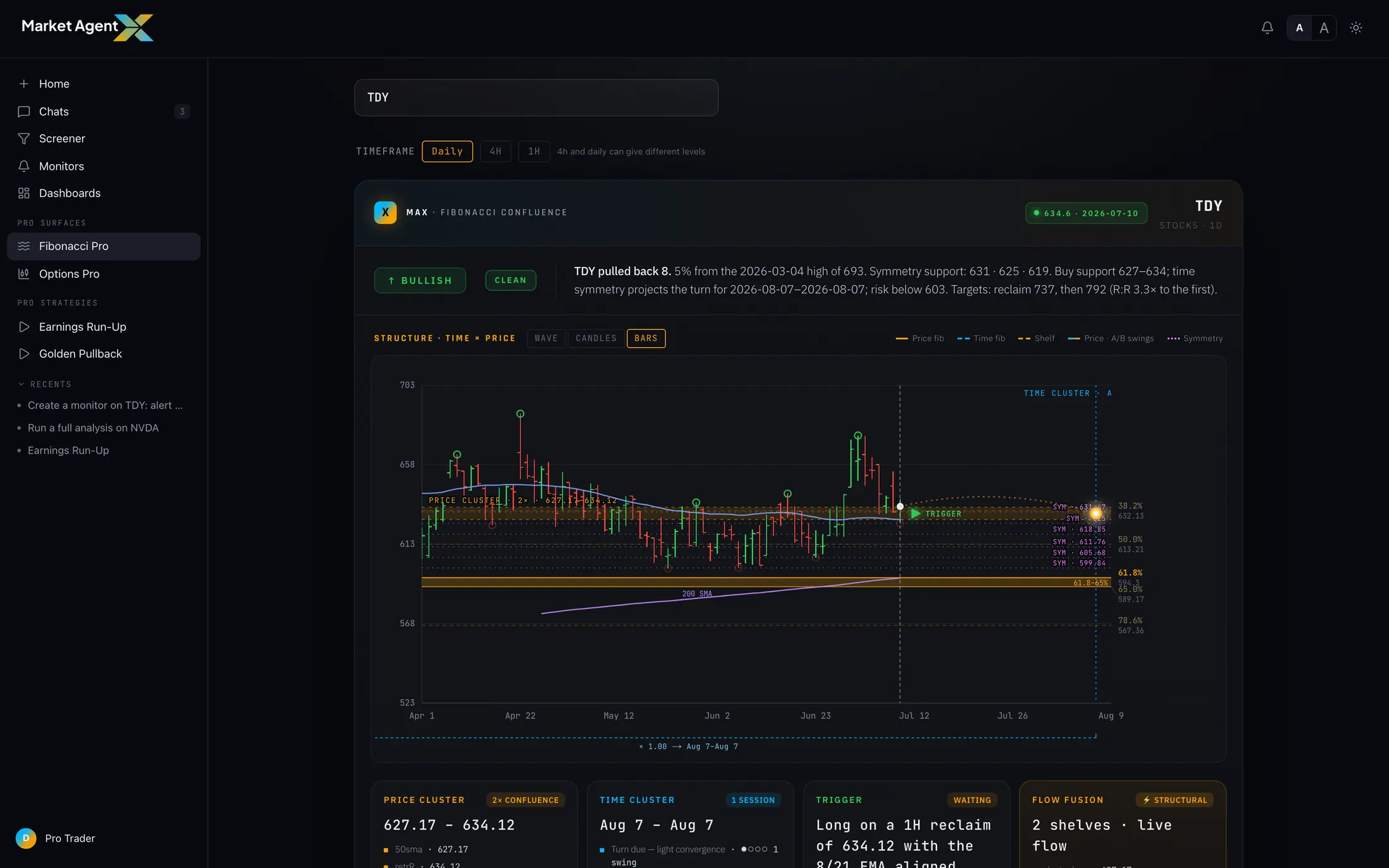
Fibonacci Pro
A study surface for price-and-time Fibonacci work: retracement and extension clusters, the confluence zones where independent measurements stack, time cycles and timing windows, and a structure–time–price view that puts all three dimensions on one chart. It works across stocks, futures, forex, and crypto, and — critically — it honors your own swing selections rather than forcing an automated read on you.
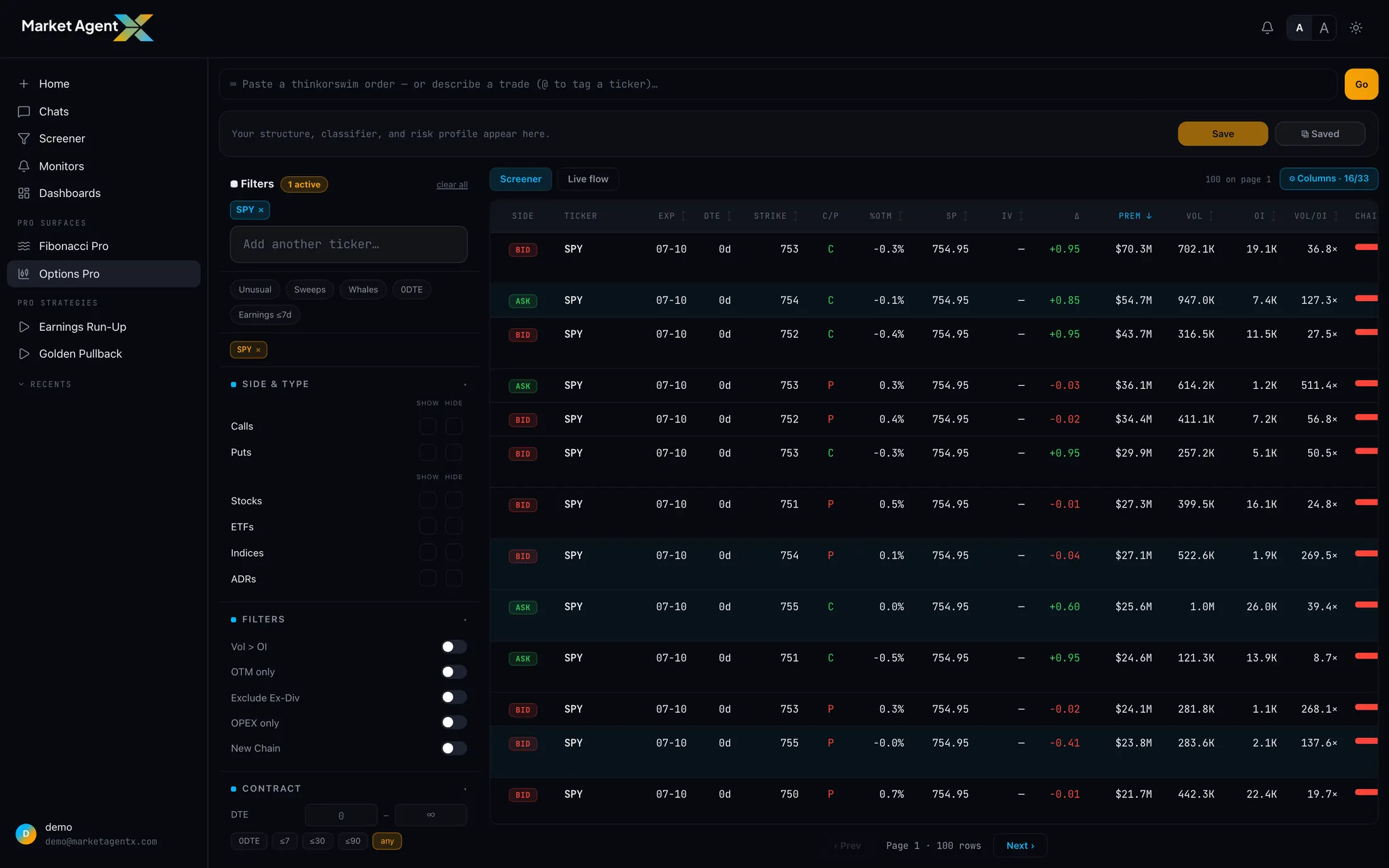
Options Pro
A construction surface for derivatives: live options chains with real quotes and Greeks, the flow behind them, a visual multi-leg position builder, payoff modeling, and a library of 35+ named structures — from simple verticals to jade lizards — that you can assemble, adjust, and export.
Who these were built with
Neither surface was designed from a textbook. Both were developed in working sessions with practitioners who use these methods every day — institutional traders, fund managers, and professional instructors who teach the methodologies to other traders. The build pattern was consistent: watch how the professional actually works, identify the measurements and decisions they repeat, and codify that loop into the interface. When the practitioner's workflow and the surface disagreed, the surface changed.
Plenty of platforms ship a "Fibonacci tool" — a drawing widget that puts static lines on a chart. Codifying a method is different: it means the surface knows which measurements matter, how they combine into confluence, what sequence the analysis follows, and where the practitioner insists on human judgment. That knowledge only comes from building alongside people who live in the method.
How Pro Surfaces fit the rest of the workspace
A Pro Surface isn't a separate app bolted on the side. It sits on the same data layer and the same intelligence layer as everything else in Market Agent X:
- Same data. Fibonacci Pro measures the same institutional-grade price history the screener and dashboards read. Options Pro builds against the same live chains and flow that feed the Options Overview.
- Same intelligence. MAX is present in both surfaces. You can run a Fibonacci confluence study from chat and step into Fibonacci Pro to work the chart; you can sketch an options idea in conversation and carry it into the builder.
- Same loop. Screen for candidates in the screener, study one on a Pro Surface, then set a monitor on the level or condition that came out of the study. The surfaces slot into the Screen → Study → Structure → Monitor workflow rather than replacing it.
Think of the workspace as having two speeds. Chat is the fast lane — ask, get a grounded answer, move on. Pro Surfaces are the deep lane — a dedicated room for the methods that reward sustained, structured work. Most sessions use both.
Where this is going
The pattern generalizes. Any methodology with a defined practice — a measurement vocabulary, a decision sequence, a visual grammar — is a candidate for the same treatment. Fibonacci Pro and Options Pro are the first two because they came from practitioners who were ready to codify. We cover each in depth in its own post: Inside Fibonacci Pro and Inside Options Pro.
Work the method, not the tool
Two professional methodologies, each with a dedicated workspace — on the same data and intelligence layer as the rest of Market Agent X. Start your 7-day trial and open one.
Start 7-Day Trial →